
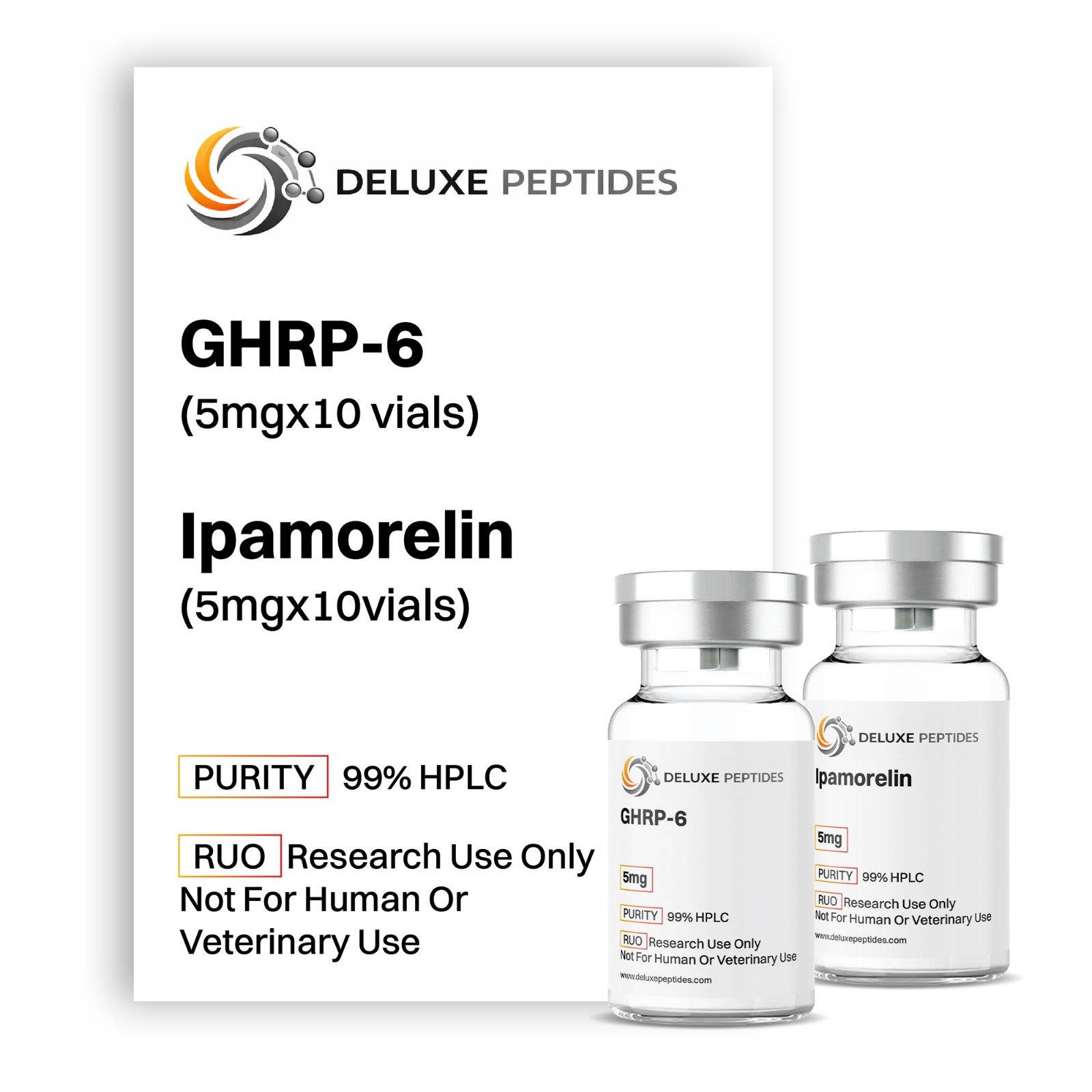
GHRP-6 and Ipamorelin – Research Overview
GHRP-6 and Ipamorelin are synthetic research peptides commonly utilized together in experimental models to investigate growth hormone axis regulation and pituitary receptor signaling. Both compounds interact with the growth hormone secretagogue receptor (GHS-R1a), also known as the ghrelin receptor, yet they demonstrate distinct pharmacological characteristics in laboratory environments.
GHRP-6 is a hexapeptide growth hormone secretagogue that activates GHS-R1a and engages Gq/PLC-dependent calcium signaling pathways. Ipamorelin is a selective pentapeptide GHS-R1a agonist that promotes calcium-mediated signaling while exhibiting comparatively minimal interaction with other pituitary hormone systems in preclinical research models.
The combined use of GHRP-6 and Ipamorelin allows researchers to explore complementary receptor dynamics, pharmacological selectivity, and somatotropic pathway modulation within controlled in vitro systems.
This stack is intended strictly for laboratory research and analytical investigation.
Molecular Characteristics
GHRP-6
GHRP-6 (Growth Hormone Releasing Peptide-6) is a synthetic hexapeptide designed to activate the GHS-R1a receptor. In research settings, GHRP-6 is studied for:
-
Ghrelin receptor activation
-
Gq protein–coupled signaling
-
Phospholipase C (PLC) pathway engagement
-
Inositol triphosphate (IP3) production
-
Intracellular calcium mobilization
-
Hypothalamic–pituitary feedback mechanisms
GHRP-6 has been widely referenced in early secretagogue research examining growth hormone axis dynamics and receptor pharmacology.
Ipamorelin
Ipamorelin is a synthetic pentapeptide classified as a selective GHS-R1a agonist. Structurally distinct from hexapeptide secretagogues, Ipamorelin is frequently studied for its receptor specificity in laboratory models.
Research involving Ipamorelin focuses on:
-
Selective GHS-R1a activation
-
Calcium-mediated signaling pathways
-
Reduced off-target pituitary hormone system interaction
-
Controlled somatotropic pathway investigation
-
Receptor pharmacodynamics analysis
Ipamorelin’s selective activation profile makes it useful in experiments evaluating receptor-specific signaling responses.
Mechanism of Action (Research Context)
In laboratory research systems, both GHRP-6 and Ipamorelin bind to the GHS-R1a receptor located primarily on anterior pituitary somatotroph cells.
Upon receptor activation, intracellular events may include:
-
Activation of phospholipase C (PLC)
-
Generation of IP3
-
Mobilization of intracellular calcium stores
-
Activation of protein kinase C (PKC)
-
Modulation of transcriptional signaling pathways
GHRP-6 demonstrates broader receptor activation characteristics, while Ipamorelin is frequently described in research literature as having more selective signaling behavior within experimental models.
When used together, GHRP-6 and Ipamorelin enable investigation of:
-
Complementary receptor activation profiles
-
Signal amplification models
-
Receptor cross-talk dynamics
-
Comparative intracellular cascade intensity
-
Somatotropic axis modulation
This dual-peptide framework supports structured research examining GHS-R1a pharmacology and endocrine signaling complexity.
Research Applications
GHRP-6 and Ipamorelin are frequently referenced in laboratory investigations involving:
-
Growth hormone secretagogue receptor pharmacology
-
GHS-R1a signaling pathway analysis
-
Hypothalamic–pituitary axis modeling
-
Calcium-dependent intracellular cascade studies
-
Somatotropic pathway regulation research
-
Comparative secretagogue receptor activation experiments
In molecular biology and endocrine research laboratories, this peptide combination serves as a model system for evaluating receptor selectivity and complementary activation patterns within the growth hormone axis.
Complementary Signaling Dynamics
The combined research use of GHRP-6 and Ipamorelin provides insight into how structurally distinct GHS-R1a agonists may produce varying intracellular responses.
Comparative investigations may analyze:
-
Relative receptor binding affinity
-
Signal onset kinetics
-
Calcium flux intensity
-
Receptor desensitization patterns
-
Feedback loop modulation within the hypothalamic–pituitary axis
By examining these parameters, researchers can better understand somatotropic pathway regulation and receptor pharmacodynamics in controlled experimental settings.
Stability and Laboratory Handling
GHRP-6 and Ipamorelin are supplied in lyophilized form to preserve molecular integrity and reduce hydrolytic degradation prior to reconstitution.
For laboratory research use:
-
Store under recommended refrigerated conditions
-
Avoid repeated freeze–thaw cycles
-
Reconstitute using sterile laboratory-grade solvent
-
Follow institutional peptide handling protocols
Lyophilization enhances long-term stability and ensures consistent peptide performance across structured experimental applications.
Scientific References
Research involving GHRP-6 and Ipamorelin frequently cites foundational studies including:
-
Bowers CY et al., Ann NY Acad Sci, 1998 865:244–249
-
Smith RG et al., Science, 1997 275(5304):1261–1264
-
Svensson J et al., J Endocrinol Invest, 1998 21(9):692–699
These studies contributed to the understanding of growth hormone secretagogue receptor biology and endocrine signaling pathways.
Researchers often consult peer-reviewed databases such as the National Center for Biotechnology Information (NCBI) for expanded literature on GHS-R1a receptor mechanisms and somatotropic regulation.
Product Specifications
-
Compounds: GHRP-6 and Ipamorelin
-
Classification: Growth Hormone Secretagogues
-
Structures: Synthetic hexapeptide (GHRP-6) and pentapeptide (Ipamorelin)
-
Form: Lyophilized sterile powder
-
Appearance: White to off-white solid
-
Intended Use: Laboratory research only
Analytical Verification and Quality Standards
Each batch of GHRP-6 and Ipamorelin undergoes analytical verification to confirm identity and purity. Testing methodologies may include:
-
High-performance liquid chromatography (HPLC)
-
Mass spectrometry analysis
-
Structural sequence verification
-
Batch consistency validation
Lot identification numbers are assigned for traceability and structured research documentation.
Compliance Notice
GHRP-6 and Ipamorelin are intended strictly for laboratory research use.
These products are not approved for human consumption, therapeutic application, or clinical use. They are sold exclusively for in vitro research, analytical testing, and scientific investigation by qualified professionals.

Reviews
There are no reviews yet.